
Living With Nexus: On the Wrist, Between Places

Introduction
The Nexus was never designed to compete for attention. From the outset, it was shaped to exist quietly within it. For those who have followed Hitori over the past five years, the Nexus will feel like a clear departure from our earlier expressions, a step away from what some may describe as tribute driven interpretations of Japanese classics. In many ways, that observation is fair. At the heart of the Nexus lies an architectural approach to watchmaking, one that reflects both our own growth and that of the community we have built together. This has always been part of our ethos, even when it was still unspoken.

Rather than treating the case as a single shell, the Nexus was conceived as a composition of layers. Each surface transitions deliberately into the next, creating depth without visual weight. The form feels structured yet fluid, modern yet grounded. It draws from a period in Japanese architecture when form was allowed to question itself, when restraint mattered more than spectacle and proportion carried meaning. Silence mattered too. This is not a watch that reveals itself instantly, and we understand that. For this reason, I want to slow the pace and walk through each element with intention. After years spent designing alongside our suppliers, watchmakers, and engineers, this process becomes both an act of sharing and a personal reflection on how the watch came into being.
The Nexus is shaped by patience, proportion, and purpose. Rather than beginning with specifications or technical detail, I prefer to approach it in reverse, starting with the experience of wearing the watch in its final form. It is designed for collectors who value restraint over spectacle and proportion over numbers. Not because it lacks technical merit, but because the longer it spends on the wrist, the more it reveals, quietly, on its own terms.
Its Expression, Worn
The Nexus was never meant to fill a gap in a collection. It exists for a different moment altogether, when the pursuit of another classic dive or dress watch gives way to forming a relationship with an object. This is a watch for collectors who have spent time with the hobby, who already own many pieces and no longer seek to be impressed at first glance. Conceived as an architectural form, the Nexus departs from traditional case construction, using layers to create depth without bulk. Its presence is not immediate. Most only begin to notice it after living with it. The Nexus does not impose a mood on the wrist but simply holds one. Quietly, through proportion, restraint, and time.
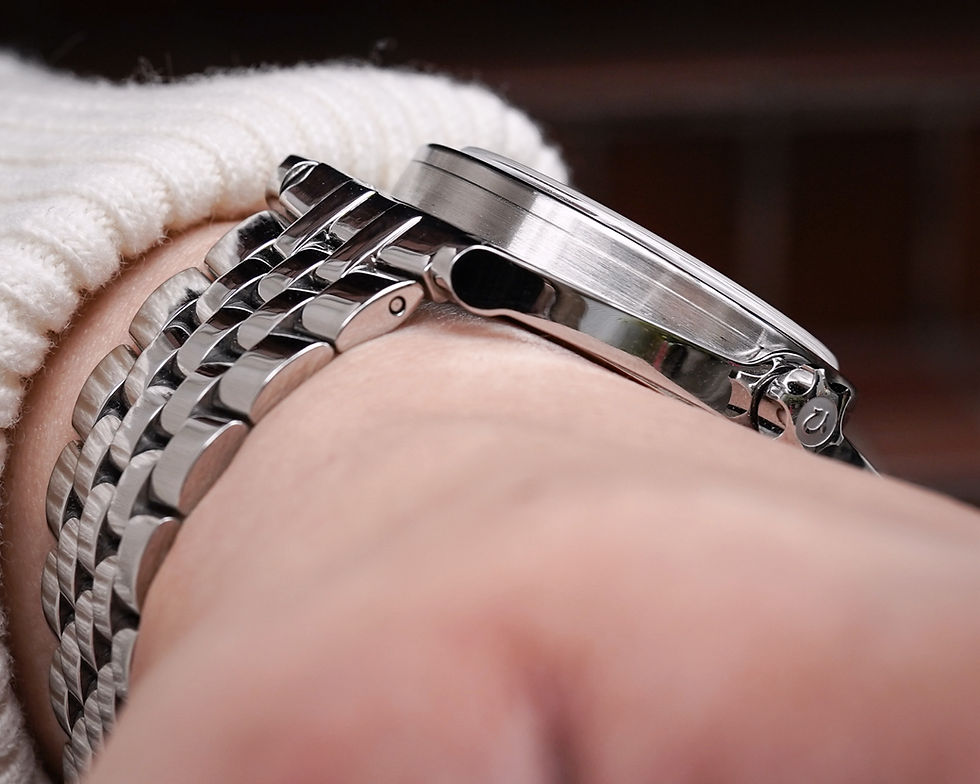
The true character of the Nexus emerges through wear. The case settles naturally, its layered architecture distributing visual weight in a way that feels balanced and unforced. From above, it may appear bold, yet from every other angle it wears with quiet ease, shedding any sense of physical heaviness. Over time, the watch becomes less about how it looks and more about how it feels, present without announcing itself. It is designed to disappear when needed and to reappear only when noticed, shaped by observation of space, light, and restraint. Every surface exists with intent. Nothing is decorative for its own sake.
This does not mean the Nexus is meant to slip entirely under the radar, forgotten by both wearer and observer alike. The high level polishing found throughout the watch, from the applied indices and dial texture to the multi finished case and bracelet, serves as a quiet reminder of its depth and intention. It carries a sense of premium architectural expression, yet wears almost imperceptibly. That balance between presence and restraint is precisely where the Nexus finds its voice.

Travel Alters the Sense of Time
I want to share my personal experience living with the final forms of Hanaasagi 花浅葱 and Shirakawa 白川. From the first prototype in early July, more than a year and a half after the initial sketches, to the final sample in October fitted with the Karumo bracelet, a component that took just as long to design and engineer, the watch revealed itself slowly. At first, it felt elusive, difficult to define, and that was precisely its strength.
What immediately stood out was how naturally it wrapped around my wrist. The rounded, downward sloping lugs and carefully balanced lug to lug length allowed the watch to sit with ease. As I moved my arm, the design flow became clear, running seamlessly from the mid case through the bracelet links and into the clasp. Every detail aligned with my original intention, a watch that feels slim, continuous, and fluid when worn.
It would be easy to mistake the Nexus for a simple dress watch because of its slender profile, but that assumption fades quickly. Viewed from the side or from above while checking the time, the layered case architecture reveals itself, creating depth and visual interest without heaviness. The complexity emerges quietly, rewarding attention rather than demanding it. This balance between elegance and structure, restraint and presence, defines the wearing experience.

Since then, I began wearing the watch as part of my everyday life, bringing it along through as many moments as possible in order to understand it more deeply. Designing it from the ground up was one thing. Living with it was another. Mornings often began earlier than planned, evenings stretched longer than expected, and somewhere between unfamiliar hotel beds and the steady rhythm of daily routines, each day found its own pace. In those moments, the Nexus slipped naturally onto my wrist without thought. Not because it felt appropriate, but because it never asked to be. That was when I realised it was designed to follow one’s rhythm, not dictate it.
My mornings often begin at a café, early enough that the air still carries a trace of the night before. Chairs scrape softly across the floor. The coffee machine hums as milk is frothed for lattes. Cups are set down with care. Light filters through glass before the city decides how busy it wants to be. As the coffee cools, the Nexus rests on my wrist, catching a brief sliver of light before settling back into stillness.
There is nothing here that needs to be photographed. Nothing that asks to be explained.

The watch does not compete with the ritual. It does not interrupt the quiet of those mornings. It simply exists within it, like the weight of a coffee cup in the hand or the soft sound of pages turning nearby. Time feels slower in these spaces, and the Nexus seems to understand that. It does not rush the hour. It holds it.
Later, moving between places, the city reveals itself in fragments. Corners. Crossings. Reflections in windows that are not yours, yet you coexist within them. The watch moves with the wrist, never pulling attention away from where you are going, yet quietly noticed. After a while, you forget it is there again. That is not absence. That is harmony.
Back in the studio, in meetings, or running errands through the day, the Nexus feels as comfortable as any sports watch I have worn, without the bulk or weight. Its lightness comes as a surprise, shaped by careful cutouts and proportions, something you only truly understand once it is on the wrist.
By evening, when the streets soften and the day loosens its grip, the Nexus continues to sit quietly as I head out for dinner with family or friends. Streetlights stretch shadows across the pavement before giving way to warm interiors and unhurried conversations. In those moments, I notice the case picking up warmth from artificial light, edges softening, the dial settling naturally into the case and bracelet as depth emerges where it was invisible before. The watch does not glow or announce itself. It simply reflects what is already there.
This is when everything feels most honest. Not at landmarks or destinations, but in the intervals between them. Moments when you are neither arriving nor leaving, just moving through space and light. It is there that the Nexus feels most at home.
When Function Works as Quietly as Form

What I am trying to express, above all, is that the Nexus is a watch chosen for excellence without applause. It is designed for those who value how something wears, how it lives with you day to day, even when its understated, slightly avant garde character goes unnoticed. There is a quiet confidence in that choice, one rooted not in attention, but in intention.
I tested this belief by placing the Nexus into bolder environments. Swim laps. Cold winter days during my return to Kyushu in December. Underwater, it simply did what it was meant to do, handling movement and pressure without hesitation. Away from controlled settings, it felt even more at home.
During the first month with the final Nexus, I travelled with my family to Malaysia and Tokyo, swimming regularly in the apartment pool. It was a deliberate shift, moving beyond its slender proportions and allowing it to operate in a more physical context. When designing Hitori watches, I have always pushed one question further. How slim can a watch be while still offering water resistance that genuinely holds up in real life. The Meguro GMT proved that philosophy through use. The Nexus took it further. Despite its dress watch like dimensions and architectural cutouts, achieving a solid 100 metres of water resistance was no small task.
What matters is not what is written, but what is lived.


Whether swimming freestyle or breaststroke, the Nexus moved effortlessly with each motion. Pausing to breathe, I often found myself taking another moment just to look at it. In motion, it felt louder than it ever did at a café table or desk, yet without becoming the bulky presence of a traditional diver. The closest comparison in confidence would be my own Submariner, though the Nexus is not a dive watch. That contrast reinforced a belief I hold deeply. A watch with depth must prove itself beyond specifications.
Another moment that affirmed this came during my return to Kyushu, the land that inspired the inaugural models. Wearing the Nexus there felt natural, almost inevitable. Like driving a vintage Alfa Romeo through Lombardy, the object only truly makes sense when placed back into its landscape. Revisiting places like Nexus World in Fukuoka and drifting through the winter quiet of Yanagawa’s canals, I found myself reconnecting with the original reasons behind the design. Kyushu carries tradition and place in a way few regions do. The Nexus is shaped by that belief, that good design does not announce itself.


Often, travel amplifies objects that demand attention. Well known watches feel louder. Recognisable forms feel heavier. The Nexus does the opposite. It adapts. It recedes when needed and reappears only when space and light invite it. When the day ends and the watch comes off, there remains a quiet sense of having worn something special.
Not watches that define moments, but watches that allow moments to remain intact.
Final Thoughts on the Wearing Experience

The Nexus stands as Hitori’s architectural expression of a wristwatch. Its character is shaped not by ornament, but by structure. A layered case creates depth without visual weight, informed by modern Japanese architectural thinking and a sensitivity to proportion that only becomes apparent through wear. It is a form designed to be understood over time, not at first glance.
It is not a watch that seeks immediate admiration. Made for collectors who value restraint over spectacle and proportion over excess, the Nexus reveals itself gradually. There are brief moments when light catches its edges and surfaces, followed by longer stretches when it disappears entirely into the rhythm of the day. The relationship deepens not through display, but through familiarity.

Since its inception, I have worn the Nexus daily, treating it as both companion and quiet study. Each hour on the wrist informs how it might wear better, feel lighter, settle more naturally. Refining materials and silhouettes remains an ongoing pursuit, guided by lived experience rather than assumption.
That sense of restraint is not imposed but sustained, and it defines how the Nexus exists on the wrist. In a landscape where many watches perform by projecting identity through labels of tool, heritage, luxury, or adventure, the Nexus chooses to remain understated. It does not demand attention when first worn, nor does it attempt to explain itself through specifications or surface drama. Instead, it allows proportion, depth, and the movement of light across its form to speak in their own time. Like music that settles quietly into the background and slowly shapes the atmosphere, the Nexus becomes part of the day rather than an interruption to it.
Let it sit.
It has a way of speaking on its own.
⸻
Field Notes No. 04


Comments